


Introduction
Automation has evolved rapidly over the past decade—from simple rule-based systems to intelligent AI-driven workflows. But now, a new concept is gaining traction: Agentic Process Automation (APA).
Unlike traditional automation, which follows predefined rules, agentic automation introduces AI agents that can think, decide, and act autonomously. This shift is transforming industries, especially in software development, business operations, and enterprise workflows.
In this blog, we’ll explore:
- What is agentic process automation
- Agentic automation meaning
- How agentic AI differs from traditional automation
- AI agent workflow automation for software development
- Business benefits of AI agents automation
- Top agentic automation platforms
What is Agentic Process Automation?
Agentic Process Automation (APA) is a modern automation approach that uses AI agents to execute tasks autonomously, make decisions, and adapt to changing environments without constant human intervention.
Unlike traditional automation, which relies on static rules, agentic automation systems:
- Understand context
- Make decisions dynamically
- Learn from interactions
- Handle complex workflows
Simple Definition:
Agentic automation = AI agents + decision-making + adaptive workflows
Example:
A traditional automation tool might:
- Send an email when a form is submitted
An agentic AI system can:
- Analyze the form
- Decide priority level
- Assign it to the right team
- Follow up automatically
Agentic Automation Meaning
The term “agentic” comes from the word agency, meaning the ability to act independently.
So, agentic automation meaning refers to:
Automation powered by AI systems that can act independently, make decisions, and complete tasks without predefined instructions.
Key Characteristics:
- Autonomy
- Intelligence
- Goal-oriented behavior
- Continuous learning
What is Agentic Automation?
If you’re wondering “what is agentic automation?”, here’s a deeper explanation:
Agentic automation is a system where AI agents perform tasks like humans, including:
- Planning
- Reasoning
- Executing workflows
- Optimizing results
These AI agents can collaborate with each other to complete complex processes.
Real-World Use Case:
In customer support:
- AI agent reads a query
- Understands intent
- Searches knowledge base
- Generates response
- Escalates if needed
Agentic AI Process Automation Explained
Agentic AI process automation combines:
- Machine Learning
- Natural Language Processing (NLP)
- Decision Intelligence
- Workflow Automation
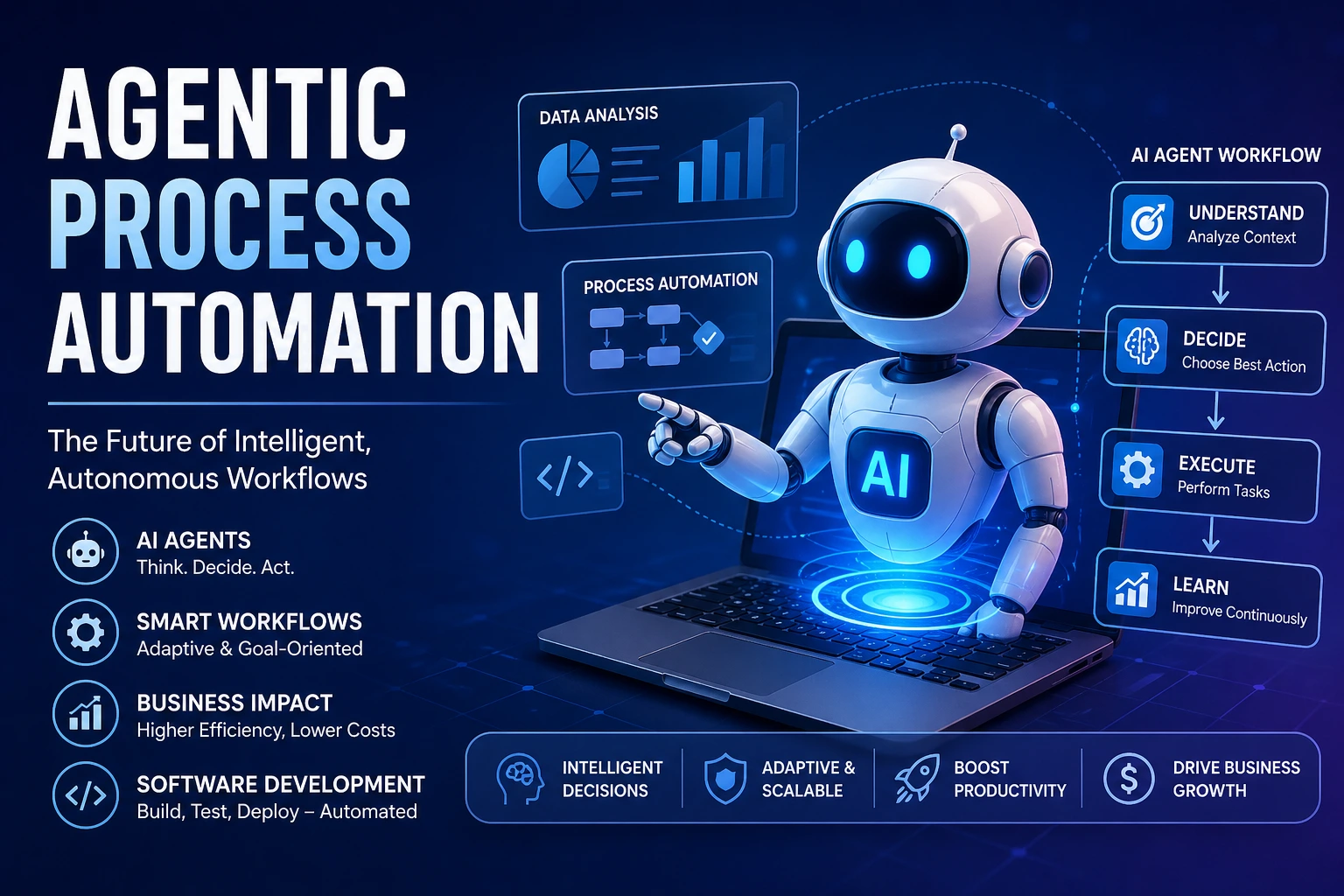
How It Works:
- Input Understanding
AI analyzes data (text, voice, logs) - Decision Making
Chooses the best action based on context - Execution
Performs tasks automatically - Learning Loop
Improves over time using feedback
How Does Agentic AI Differ from Traditional Automation?
This is one of the most searched questions:
“How does agentic AI differ from traditional automation?”
Key Differences:
| Feature | Traditional Automation | Agentic AI Automation |
|---|---|---|
| Logic | Rule-based | AI-driven |
| Flexibility | Low | High |
| Decision-making | No | Yes |
| Learning | None | Continuous |
| Adaptability | Static | Dynamic |
Example Comparison:
Traditional Automation:
- If X happens → Do Y
Agentic AI:
- Understand X
- Analyze context
- Decide best action
- Execute dynamically
👉 In short:
Traditional = scripted
Agentic = intelligent
AI Agent Workflow Automation for Software Development
One of the most powerful applications is in software development.
What is AI Agent Workflow Automation for Software Development?
It involves using AI agents to:
- Write code
- Debug errors
- Run tests
- Deploy applications
- Monitor performance
Use Cases:
1. Code Generation
AI agents can generate production-ready code based on prompts.
2. Bug Fixing
Automatically detect and fix errors.
3. CI/CD Automation
Agents manage build pipelines and deployments.
4. Code Review
AI reviews code for quality and security issues.
Example Workflow:
- Developer writes requirement
- AI agent generates code
- Another agent tests it
- Deployment agent pushes to production
Agentic Automation Platform: What to Look For
If you’re planning to adopt this technology, choosing the right agentic automation platform is critical.
Key Features:
- AI agent orchestration
- Workflow automation tools
- NLP capabilities
- API integrations
- Real-time decision making
Popular Platforms (Examples):
- OpenAI-based agent systems
- LangChain frameworks
- AutoGPT / Agent frameworks
- Enterprise AI automation tools
AI Agents Automation Business Benefits
Businesses are rapidly adopting agentic automation due to its high ROI and efficiency gains.
1. Increased Productivity
AI agents handle repetitive and complex tasks.
2. Cost Reduction
Less reliance on manual labor.
3. Faster Decision-Making
Real-time analysis and execution.
4. Scalability
Easily scale operations without hiring.
5. Improved Accuracy
Reduced human error.
Real-World Applications of Agentic Automation
1. Customer Support
- AI chatbots with decision-making ability
- Ticket resolution automation
2. Finance
- Fraud detection
- Automated trading strategies
3. Marketing
- Campaign optimization
- Content generation
4. Healthcare
- Diagnosis assistance
- Patient data management
5. E-commerce
- Personalized recommendations
- Inventory management
Future of Agentic Process Automation
Agentic automation is not just a trend—it’s the future of work.
What to Expect:
- Fully autonomous businesses
- AI employees (digital workers)
- Self-optimizing workflows
- Human-AI collaboration
Emerging Trends:
- Multi-agent systems
- AI copilots in every industry
- Autonomous decision engines
Challenges of Agentic Automation
Despite its benefits, there are some challenges:
1. Data Privacy
Handling sensitive data securely
2. Ethical Concerns
AI decision-making transparency
3. Integration Complexity
Adapting existing systems
4. Cost of Implementation
Initial setup can be expensive
How to Implement Agentic AI in Your Business
Step-by-Step Approach:
- Identify repetitive and decision-heavy tasks
- Choose the right AI tools/platform
- Start with small automation projects
- Train AI models using data
- Monitor and optimize continuously
FAQs
What is agentic process automation in simple terms?
Agentic process automation is the use of AI agents to automate tasks with decision-making capabilities and adaptability.
How does agentic AI differ from traditional automation?
Traditional automation follows fixed rules, while agentic AI can think, decide, and adapt dynamically.
What are AI agents in automation?
AI agents are intelligent systems that perform tasks autonomously, analyze data, and make decisions.
Can agentic automation replace human jobs?
It may replace repetitive tasks, but it will also create new roles focused on managing and optimizing AI systems.
What industries benefit the most from agentic automation?
Software development, finance, healthcare, marketing, and e-commerce benefit the most.
Is agentic automation expensive?
Initial setup can be costly, but long-term ROI is high due to efficiency gains.
What is an agentic automation platform?
It is a system that enables AI agents to automate workflows, make decisions, and integrate with business processes.
How is agentic AI used in software development?
It helps in coding, testing, debugging, deployment, and performance monitoring.
Conclusion
Agentic Process Automation is redefining how businesses operate by introducing intelligent, autonomous systems. Unlike traditional automation, it brings decision-making, adaptability, and learning capabilities into workflows.
As AI continues to evolve, companies that adopt agentic automation early will gain a significant competitive advantage.
