



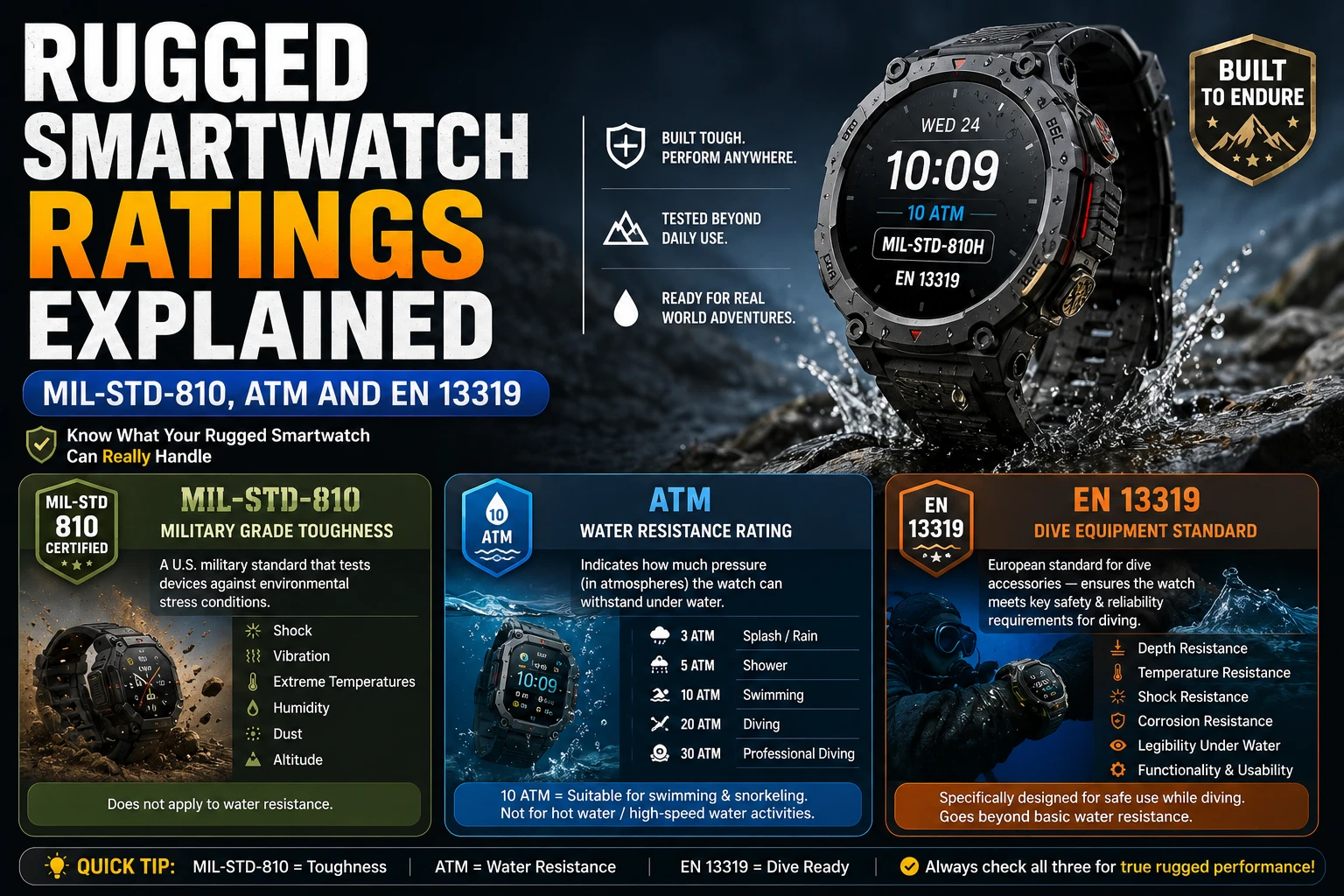
“Rugged” on a smartwatch box means one of three specific things, and only one of them is a standard you can check: MIL-STD-810 testing, a water rating in ATM or metres, and — if the watch claims diving — compliance with EN 13319. A watch that lists all three has been tested. A watch that says “durable design” and nothing else has not.
That distinction is the whole buying decision. Below is what each rating actually certifies, followed by three watches that publish their numbers in full — the Garmin Instinct 3, the Garmin fēnix 8 and the Apple Watch Ultra 3 — and how to read the gap between them.
The three ratings that mean something
MIL-STD-810 — shock, temperature, altitude
A US military test methodology, not a pass/fail certification. That is the catch: manufacturers choose which subsections to test against, so “MIL-STD-810 tested” without a list of subsections tells you very little.
Compare how two vendors state it. Garmin says the Instinct 3 Series is “built to MIL-STD 810 for thermal and shock resistance” — two named categories. Apple publishes a longer list for the Watch Ultra 3: tested to MIL-STD 810H against subsections for altitude, high temperature, low temperature, temperature shock, immersion, freeze with thaw, ice and freezing rain, and shock and vibration.
Neither is dishonest. The second is simply more specific, and specificity is what you are shopping for. When a spec sheet names the subsections, believe it. When it says only “military standard,” treat it as marketing.
Water rating — ATM, metres and what they do not mean
Water ratings are static pressure tests, not depth permissions. A 10 ATM rating means the device withstands pressure equivalent to a depth of 100 m in a laboratory; it does not mean you can dive to 100 m, because swimming, diving and jet-ski impacts add dynamic pressure the test never applies.
This is why the serious watches carry two water ratings. Garmin lists the fēnix 8 at 10 ATM and separately at 4 ATM Dive (EN 13319). Apple lists the Watch Ultra 3 at 100 m under ISO standard 22810:2010 for swimming, snorkelling, scuba and high-speed water sports, and separately at EN 13319 recreational scuba diving to 40 m.
The general rating covers getting wet. The dive rating covers being used as dive equipment. They are not the same claim.
EN 13319 — the one that matters for diving
The European standard for diving accessories, covering depth gauges. If a watch claims scuba capability without citing EN 13319 or an equivalent, it is a swim watch with a depth reading, not a dive computer.
Both Garmin and Apple cite it at the same depth: 40 m. Apple specifies ±1 m accuracy for its depth gauge; Garmin specifies its depth sensor as accurate from 0 m to 40 m complying with EN 13319, with 0.1 m resolution to 45 m. Garmin adds the Bühlmann ZHL-16C decompression model, the algorithm family used in dedicated dive computers.
Three watches that publish their numbers
| Garmin Instinct 3 | Garmin fēnix 8 | Apple Watch Ultra 3 | |
|---|---|---|---|
| Shock standard | MIL-STD 810, thermal and shock | Tested to US military standards for thermal, shock, water | MIL-STD 810H, 8 named subsections |
| Water rating | 100 m | 10 ATM | 100 m (ISO 22810:2010) |
| Dive rating | — | 4 ATM Dive, EN 13319, to 40 m | EN 13319, scuba to 40 m (±1 m) |
| Case | Metal-reinforced bezel, fibre-reinforced polymer | Leakproof metal buttons, optional titanium bezel and sapphire lens | Grade 5 titanium |
| Sizes | 45, 50 mm | 43, 47, 51 mm (AMOLED) | 49 mm |
| Battery, normal use | Up to 24 days (AMOLED, smartwatch mode) | Up to 29 days (51 mm AMOLED, gesture) | Up to 42 hrs; 72 hrs low power |
| Launch price | From $399.99 Solar / $449.99 AMOLED | From $999.99 | See Apple for current pricing |
The battery row is where the category splits in two, and it is not close. Garmin measures rugged watch battery life in weeks; Apple measures it in hours — up to 42 hours of normal use, or 72 hours in Low Power Mode. Apple offsets this with fast charging: 15 minutes for up to 12 hours of normal use.
If your definition of rugged includes “works on day four of a trip with no power,” that row decides the purchase before any other spec does.
Garmin Instinct 3 — the value pick
MIL-STD 810 for thermal and shock, water-rated to 100 m, metal-reinforced bezel over a fibre-reinforced polymer case, and a built-in LED flashlight on every model with variable intensities, a red light and a strobe. Available at 45 mm and 50 mm in AMOLED or solar.
Garmin’s battery claim for the Solar models is the eye-catching one: “the solar charging models can get unlimited battery life” in smartwatch mode — a claim that carries the footnote “assumes all-day wear, 3 hours per day outside in 50,000 lux conditions.” That footnote is doing real work. 50,000 lux is bright direct sun. Indoor office light is a small fraction of it. Read the claim as “indefinite in summer daylight, finite otherwise.”
Garmin fēnix 8 — the one that dives
The step up buys sealing rather than sensors: leakproof metal buttons, a 40-metre dive-rated case, scuba and apnea dive activities, plus a speaker and microphone for calls and offline voice commands. Operating range is −20 °C to 45 °C. Our full breakdown of the Garmin fēnix 8 covers the battery tables per size and mode.
Apple Watch Ultra 3 — the one that is also a smartwatch
Grade 5 titanium case, 100 m water resistance under ISO 22810:2010, EN 13319 recreational scuba to 40 m with a ±1 m depth gauge, and the most explicitly documented MIL-STD-810H subsection list of the three. It is the strongest choice if the watch is also your phone-on-the-wrist — and the weakest on battery by an order of magnitude.
What “rugged” does not cover
Three failure modes no rating protects against, and all three are how rugged watches actually die:
- Screen scratches. Shock ratings test impact survival, not surface hardness. Sapphire is the upgrade that addresses this, and it is optional on the fēnix 8 for a reason — it costs more.
- Water rating decay. Seals age. A five-year-old 10 ATM watch is not a 10 ATM watch. Garmin’s own guidance is to inspect parts before each use for damage and replace as needed.
- Charging in the cold. The fēnix 8 operates down to −20 °C but only charges between 0 °C and 45 °C. Bringing a frozen watch straight to a charger does nothing until it warms.
How to choose in one paragraph
If you dive, you need EN 13319 — that narrows the field to the fēnix 8 and the Watch Ultra 3. If you are off-grid for more than two days, battery life narrows it to Garmin. If the watch is primarily a smartwatch that also survives a hike, the Ultra 3’s titanium case and documented MIL-STD-810H subsections are the strongest specification on paper. And if the budget is the constraint, the Instinct 3 delivers MIL-STD 810 thermal and shock plus a 100 m water rating from $399.99 — the same two ratings that matter most, for less than half the fēnix 8’s launch price.
Frequently Asked Questions
What does MIL-STD-810 actually certify on a smartwatch?
Nothing on its own — it is a test methodology, not a pass/fail certification, and manufacturers pick which subsections to test against. Garmin describes the Instinct 3 as built to MIL-STD 810 for thermal and shock resistance; Apple lists eight named subsections for the Watch Ultra 3, including altitude, immersion, freeze with thaw, and shock and vibration. Prefer spec sheets that name the subsections.
Can I scuba dive with a 100-metre water-rated smartwatch?
Not on that rating alone. A 100 m or 10 ATM rating is a static pressure test. Diving requires a separate dive rating — both the Garmin fēnix 8 and the Apple Watch Ultra 3 cite EN 13319 compliance for recreational scuba to 40 m, and both publish depth-sensor accuracy figures. A watch without a dive standard is a swim watch.
Which rugged smartwatch has the longest battery life?
Among these three, Garmin by a wide margin. The Instinct 3 AMOLED is rated up to 24 days in smartwatch mode and Garmin markets the Solar models as capable of unlimited battery life given 3 hours a day outside in 50,000 lux. The fēnix 8 51 mm AMOLED reaches 29 days. The Apple Watch Ultra 3 is rated up to 42 hours of normal use, or 72 hours in Low Power Mode.
Is a titanium case tougher than polymer?
Not automatically. The Apple Watch Ultra 3 uses a Grade 5 titanium case, while the Garmin Instinct 3 uses a fibre-reinforced polymer case with a metal-reinforced bezel — and both pass shock testing. Polymer absorbs impact and is lighter; titanium resists deformation and scratches better. The published test results matter more than the material name.
Do smartwatch water ratings expire?
Effectively, yes. Water resistance depends on seals and gaskets that degrade with age, heat, sunscreen, soap and impacts. Garmin’s own specification sheet instructs owners to inspect parts before each use for damage and replace them as needed. Treat an old rating as a starting point, not a guarantee.
The bottom line
Ignore the word “rugged” and read three lines on the spec sheet: which MIL-STD-810 subsections were tested, what the water rating is and under which ISO standard, and whether EN 13319 appears at all. The Instinct 3 covers the basics cheaply, the fēnix 8 adds sealed buttons and real dive capability, and the Watch Ultra 3 trades weeks of battery for the best-documented durability testing and a full smartwatch. Any watch that will not tell you which subsections it passed has answered the question.
More on Tech2Post: the full Garmin fēnix 8 specification breakdown, connecting AirPods to a laptop, and the Sony Headphones Connect rename.
Related reading: the best smartphones for trekking, the DJI Osmo Pocket 4, which iPhones have eSIM for travel data, what latency actually means, screenshots on any device, and the Samsung Galaxy Z Fold 8.
Sources: Garmin — Instinct 3 Series announcement, Garmin fēnix 8 Owner’s Manual — Specifications and Apple — Apple Watch Ultra 3 Technical Specifications. All ratings, standards, battery figures and prices are quoted from those pages.


