


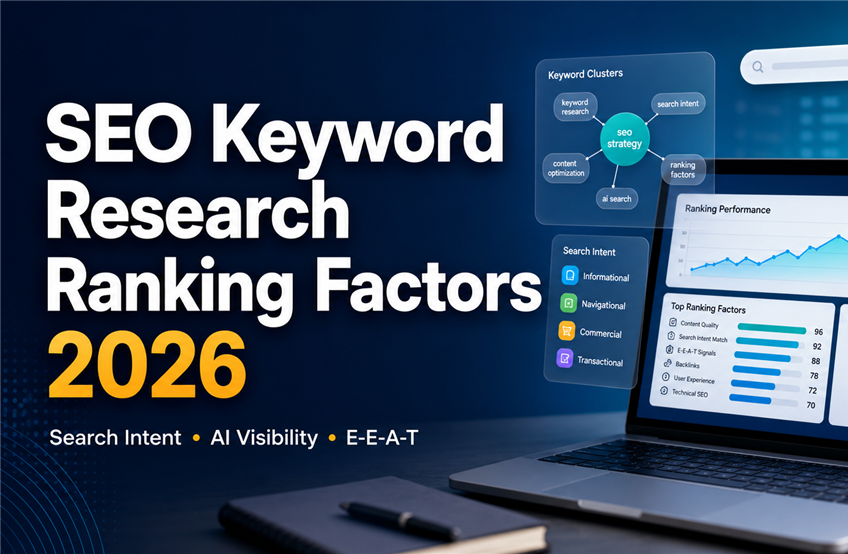
SEO in 2026 is no longer just about finding keywords and placing them inside a page. Search has become more intent-driven, AI-assisted, and quality-focused. Google’s systems are designed to reward helpful, reliable, people-first content, while AI Overviews and conversational search experiences are changing how users discover information.
That does not mean keyword research is dead. It means keyword research has become more strategic. To rank in 2026, you need to understand what people search, why they search, what format Google rewards, and how your content can become the most useful answer.
1. Search Intent Is Still the Foundation
Search intent is the reason behind a user’s search. It is one of the most important parts of keyword research in 2026. A person searching “what is keyword research” wants education, while someone searching “best keyword research tools” is comparing options. Someone searching “SEO agency near me” is much closer to taking action.
- Is the keyword informational, commercial, transactional, or navigational?
- What type of page is already ranking?
- Does Google prefer blog posts, service pages, product pages, videos, or local results?
- What problem is the searcher trying to solve?
A page targeting seo keyword research ranking factors 2026 should be an educational article that explains the topic clearly, answers related questions, and provides practical guidance.
2. Helpful, People-First Content Matters More Than Ever
Google continues to emphasize helpful, reliable, people-first content. In simple terms, your content should be created to help readers, not just to attract search engine traffic.
- Answer the main question quickly.
- Go deeper than basic definitions.
- Include real examples and practical steps.
- Avoid keyword stuffing and generic filler.
- Make the article easy to scan on mobile and desktop.
If your content simply repeats what every other ranking page says, it will be hard to compete. Strong SEO content needs a clear point of view, useful structure, and information that genuinely helps the reader make a better decision.
3. E-E-A-T Builds Trust
E-E-A-T stands for Experience, Expertise, Authoritativeness, and Trust. It is not one single ranking factor, but it is a useful way to evaluate whether content feels credible, helpful, and trustworthy.
- Add a real author name and credentials.
- Show first-hand experience.
- Reference reliable sources.
- Include examples, screenshots, or case studies where possible.
- Keep the page updated.
Trust is especially important in 2026 because the web is full of AI-generated and mass-produced content. Readers want advice that feels tested, current, and useful.
4. AI Search Visibility Is Now Part of SEO
AI Overviews and AI-powered search experiences influence how users interact with search results. Many users now see summarized answers before they click a website. This makes content structure more important than ever.
- Use clear headings.
- Answer questions directly.
- Include concise definitions.
- Add step-by-step explanations.
- Use tables, lists, and FAQs where useful.
The goal is not only to rank as a traditional blue link. The goal is to become a trusted source that search systems can understand, summarize, and surface.
5. Topical Authority Beats One-Off Content
One blog post is usually not enough to rank for competitive SEO keywords. In 2026, topical authority is a major advantage. If your website wants to rank for SEO keyword research topics, it should also cover related subjects such as search intent, on-page SEO, technical SEO, content optimization, backlinks, and AI search strategy.
These supporting pages should internally link to each other. This helps search engines understand that your website has depth and expertise around the topic.
6. Keyword Relevance and Semantic Coverage
Exact-match keywords still matter, but modern SEO is more about topic coverage and relevance. Your page should include the focus keyword naturally, but it should also include related terms such as search intent, content quality, topical authority, backlinks, Core Web Vitals, internal linking, and organic traffic.
The goal is not to repeat the same phrase again and again. The goal is to cover the topic completely and naturally.
7. On-Page SEO Still Matters
On-page SEO helps search engines understand what your page is about. Even excellent content can underperform if the page is poorly structured.
- SEO title
- Meta description
- H1 heading
- H2 and H3 headings
- Clean URL slug
- Internal links
- Image alt text
- Schema markup
Your primary keyword should appear naturally in the SEO title, URL slug, introduction, and body content. Do not force it where it does not belong.
8. Content Freshness Is Critical for 2026 Keywords
When a keyword includes a year, freshness becomes very important. A user searching for ranking factors in 2026 expects current information, not outdated advice from previous years.
- Add a “Last updated” date.
- Review the article every three to six months.
- Update Google-related references.
- Add new AI search changes when relevant.
- Remove outdated tactics.
9. Page Experience and Core Web Vitals
Page experience still matters. A strong page should load quickly, work well on mobile, avoid intrusive popups, and make the main content easy to read.
- LCP measures loading performance.
- INP measures interactivity.
- CLS measures visual stability.
A fast page with poor content will not rank just because it is fast. But when two pages are similar in quality, better user experience can help.
10. Internal Linking Helps Google Understand Importance
Internal links help users and search engines move through your website. They also show which pages are most important.
For example, this article could internally link to pages about SEO services, keyword research services, technical SEO, local SEO, link building, and content marketing. Use descriptive anchor text instead of generic phrases like “click here.”
11. Backlinks and Brand Authority Still Matter
Backlinks remain important, especially for competitive keywords. However, quality, relevance, and trust matter more than the total number of links.
- Digital PR
- Guest posts
- Industry publications
- Original data
- Expert interviews
- Useful resource pages
Avoid spammy backlinks, private blog networks, irrelevant directories, and paid link schemes. These may create short-term movement but can damage trust over time.
12. SERP Analysis Should Guide Every Page
Before targeting any keyword, analyze the search engine results page. Look at what type of content ranks, how detailed the top pages are, whether AI Overviews appear, which People Also Ask questions are shown, and what subtopics competitors cover.
SERP analysis prevents guesswork. It helps you understand what kind of page Google wants to show for that keyword.
13. Conversion Intent Should Influence Keyword Selection
Ranking is useful only if it supports a business goal. Some keywords bring traffic but no leads. Others have lower search volume but stronger commercial value.
- Search volume
- Keyword difficulty
- Business value
- Conversion intent
- Competition level
- Funnel stage
The best keyword is not always the highest-volume keyword. It is the keyword that attracts the right audience and supports your business goals.
14. FAQs Can Capture Long-Tail Searches
What are the most important SEO ranking factors in 2026?
The most important SEO ranking factors in 2026 include search intent, helpful content, E-E-A-T, topical authority, backlinks, internal linking, page experience, and technical SEO.
Is keyword research still important in 2026?
Yes. Keyword research is still important, but it now focuses more on search intent, topic coverage, user needs, and conversion value instead of only search volume.
Does AI content rank in Google?
AI-assisted content can rank if it is helpful, accurate, original, and created for users. Low-quality automated content created mainly to manipulate rankings can perform poorly.
Are backlinks still a ranking factor in 2026?
Yes, backlinks still matter. However, quality, relevance, and trust are more important than the total number of links.
Final Thoughts
The most important SEO keyword research ranking factors in 2026 are not limited to keywords alone. Successful SEO now depends on understanding search intent, creating helpful content, building trust, improving page experience, earning authority, and structuring content for both traditional search and AI-powered search experiences.
If you want to rank for competitive keywords, start with strong keyword research. Then create content that is genuinely useful, clearly organized, technically sound, and supported by related pages across your website.
