


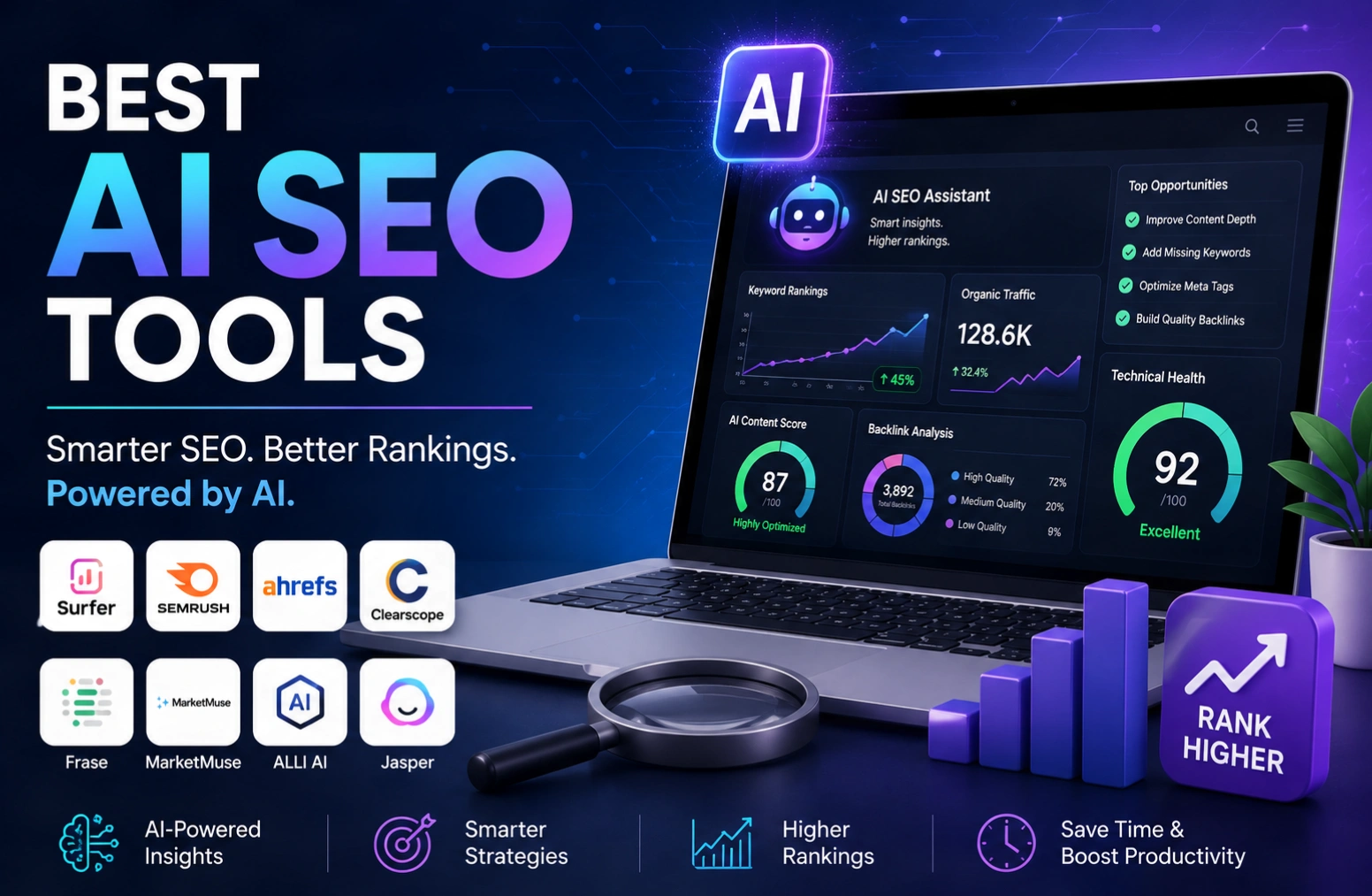
Most “best AI SEO tools” articles have a problem: their prices are wrong. While researching this one we found a widely-linked 2026 comparison listing Surfer SEO at $89 a month. Surfer’s own pricing page has no $89 tier — it runs $49, $99, $182, and $299. That is not a rounding error, it is a number someone invented and everyone else copied.
So this guide does one thing differently. Every price below was read off the vendor’s own pricing page on 29 July 2026, and every one is linked so you can check it yourself. Where a company does not publish its pricing, we say that instead of guessing.
What actually changed in AI SEO this year
If you last looked at this category in 2024, the tools were about one job: analysing the pages that rank and telling you which terms your draft is missing. That job still exists, but it is no longer where the competition is.
The shift is that every major platform added AI-visibility tracking in the last cycle — monitoring whether your brand gets cited inside ChatGPT, Perplexity, Google AI Overviews, and Gemini, rather than only where you rank in the ten blue links. Surfer sells it as AI Search Analytics, Frase as AI Visibility, Semrush folded it into its mid-tier plans, and Ahrefs launched Brand Radar AI.
This matters because the questions being asked of an SEO tool have changed. “What is my position for this keyword” is now only half the question; the other half is “does the model mention us at all.” If that framing is new to you, our guide to ranking your website in ChatGPT AI search covers the underlying mechanics, and why generative AI favours trustworthy content explains what these systems actually reward.
A note on billing: Surfer and Semrush publish annual-billing rates by default, which are lower than what you pay month to month. We state the basis every time below, because quietly comparing one vendor’s annual rate against another’s monthly rate is how these comparisons go wrong.
The six tools worth shortlisting
1. Surfer SEO — best all-round content optimisation
Surfer scores your draft against what is currently ranking and tells you what to change: terms to include, length, heading structure. It is the tool most teams mean when they say “content optimisation,” and it now scores for AI search alongside classic SERPs.
Pricing (annual billing): Discovery $49/mo · Standard $99/mo · Pro $182/mo · Peace of Mind $299/mo · Enterprise $999/mo. AI Search Analytics is also sold standalone at $158/mo. Check current pricing.
AI visibility: ChatGPT only on the lower tiers; Pro and above add Perplexity, Google AI Mode, AI Overviews, and Gemini, with daily refreshes.
Skip it if: you publish a handful of articles a month. The per-article value is real but you will not use the volume you are paying for.
2. Frase — best value, and the best AI-visibility features per dollar
Frase covers research, brief-building, and optimisation, and its AI-visibility tracking is unusually generous for the price — the entry tier includes it, which is not true of most competitors.
Pricing: Starter $39/mo annual or $49/mo monthly · Professional $103 / $129 · Scale $239 / $299 · Enterprise custom. Check current pricing.
AI visibility: ChatGPT and Google AI on Starter and Professional; Scale adds Perplexity, Claude, and Gemini, tracking up to 500 prompts.
Skip it if: you need deep site-wide technical crawling — Frase is a content tool, not a full platform.
3. Clearscope — best for enforcing quality across a large team
Clearscope does less than its competitors on purpose. It grades content against a target and it does that extremely well, with a workflow built for editors managing many writers. Teams choose it when consistency matters more than breadth of features.
Pricing: Essentials $129/mo · Business $399/mo · Enterprise custom. Check current pricing.
Skip it if: you are a solo operator. The value is in enforcing a standard across people, and there is a cheaper path to a good draft if the only writer is you.
4. Semrush — best all-in-one platform
Semrush is the broadest of these: keyword research, rank tracking, technical audits, backlinks, competitor analysis, ads data, and now AI visibility in one subscription. If you want a single tool rather than three, this is usually the answer. Its keyword data underpins the kind of analysis we describe in SEO keyword research ranking factors for 2026.
Pricing (annual billing; list price in brackets): SEO $117.33 ($139) · Starter $165.17 ($199) · Pro+ $248.17 ($299) · Advanced $455.67 ($549). Check current pricing.
AI visibility: included from the Starter plan up, tracking 50 to 200 daily prompts by tier across Google, ChatGPT, Perplexity, and Gemini.
Skip it if: you only need content scoring. You will pay for a great deal you never open.
5. Ahrefs — best for backlinks and technical depth
Ahrefs remains the strongest backlink index, and its site audit is excellent — the natural companion to the work described in our guide to technical SEO and to off-page SEO techniques. It also has the most useful free tier in this list.
Pricing: Free (Webmaster Tools for your own verified site) · Starter $29/mo · Lite $129/mo · Standard $249/mo · Advanced $449/mo · Enterprise $1,499/mo. Brand Radar AI starts at $199/mo, with prompt-tracking packages from $50/mo. Check current pricing.
Skip it if: your bottleneck is writing rather than links. Ahrefs will diagnose brilliantly and not help you draft.
6. MarketMuse — best for planning clusters, not single posts
MarketMuse works at the level above individual articles: mapping topic clusters, finding gaps across a whole site, and telling you what to write next rather than how to improve a draft. That is genuinely different from everything above it on this list.
Pricing: a free tier plus three paid plans — Optimize, Research, and Strategy. MarketMuse no longer publishes prices for the paid tiers. You will see “$149/mo” quoted in other comparisons; that figure does not appear on MarketMuse’s own pricing page, so treat it with suspicion and request a quote. See plan comparison.
Skip it if: you publish a few articles a month. This is a strategy tool for teams planning at scale.
Comparison at a glance
| Tool | Best for | Entry price | Basis | AI visibility |
|---|---|---|---|---|
| Surfer SEO | Content optimisation | $49/mo | annual | Yes — all tiers, wider on Pro+ |
| Frase | Value / briefs | $39/mo | annual ($49 monthly) | Yes — from entry tier |
| Clearscope | Team quality control | $129/mo | monthly | Not a headline feature |
| Semrush | All-in-one platform | $117.33/mo | annual ($139 list) | Yes — Starter and above |
| Ahrefs | Backlinks / technical | Free, then $29/mo | monthly | Brand Radar AI, from $199/mo |
| MarketMuse | Cluster strategy | Free tier | — | Not published |
Also worth knowing
Three categories we have not priced here, because pricing moves too fast to state responsibly without checking:
- Dedicated AI-visibility trackers. A new category of tools does nothing but monitor brand mentions inside AI answers. Worth watching if AEO is your main concern and you already have an SEO platform.
- Budget content optimisers. Several tools undercut Surfer and Frase substantially. They are viable if content scoring is all you need.
- General-purpose AI writers. Useful for drafting, but they do not analyse SERPs — pair them with something on the list above. Our roundup of the best artificial intelligence tools for daily use and the best AI productivity tools cover that ground.
How to choose, in one pass
- You want one tool for everything → Semrush.
- You want the best value including AI visibility → Frase.
- You optimise a lot of drafts → Surfer.
- You manage many writers → Clearscope.
- Your problem is links or crawl issues → Ahrefs (start with the free tier).
- You are planning a content programme, not an article → MarketMuse.
- You have no budget at all → Ahrefs Webmaster Tools plus MarketMuse’s free tier covers more than most people expect.
One caution worth stating plainly: none of these tools rank anything for you. They shorten diagnosis. If the underlying content is not better than what already ranks, a higher optimisation score changes nothing — a point our comparison of paid versus organic search makes from the other direction, and one that generative AI’s effect on SEO has made sharper, not softer.
Frequently asked questions
What is the best AI SEO tool overall?
For most teams, Semrush if you want a single platform, or Frase if you want the best combination of content features and AI-visibility tracking for the money. There is no single winner — the right answer depends on whether your bottleneck is writing, links, or planning.
Is there a genuinely free AI SEO tool?
Yes. Ahrefs Webmaster Tools is free for sites you verify ownership of and includes site audit and backlink data. MarketMuse also has a free tier. Between them you can do real work at zero cost, though both are deliberately limited compared with their paid plans.
Can AI SEO tools replace an SEO specialist?
No, and the tools themselves do not claim it. They compress research and diagnosis that used to take hours. Deciding what to build, judging whether a recommendation makes sense for your business, and writing something genuinely worth ranking all remain human work.
What is AI visibility tracking, and do I need it?
It monitors whether your brand is cited inside AI answers — ChatGPT, Perplexity, Google AI Overviews, Gemini — rather than only your position in classic search results. You need it if a meaningful share of your audience now asks an assistant instead of running a search. For most sites that share is growing but still smaller than organic search, so treat it as important and rising rather than urgent.
Why do the prices here differ from other comparison articles?
Because we read them off the vendors’ own pricing pages on 29 July 2026 and linked each one. Several widely-shared comparisons quote figures that do not match any current tier. Prices in this category also change often, so check the links before you buy.
How many of these do I need?
One, in most cases. The common mistake is subscribing to a content optimiser and a full platform that already includes content scoring. Start with the single tool that addresses your actual bottleneck and add a second only when you can name what it does that the first cannot.
